FreeCourse Logo
FreeCourse.io
Verified CouponsFree CoursesJobsBlog
Categories
Home/Courses/[NEW] Certified in Cybersecurity (CC)
[NEW] Certified in Cybersecurity (CC)
IT & Software100% OFF

[NEW] Certified in Cybersecurity (CC)

Udemy Instructor
0(0 students)
Self-paced
All Levels

About this course

Detailed Exam Domain CoverageSecurity Principles (26%): Confidentiality, Integrity, Availability, Authentication (including MFA), Privacy.Business Continuity (BC), Disaster Recovery (DR) & Incident Response Concepts (10%): Business Continuity Planning, Disaster Recovery Planning, Incident Response Process.Access Controls Concepts (22%): Identification, Authentication, Authorization, Account Management.Network Security (24%): Network Architecture, Firewalls, Secure Protocols, Network Monitoring.Security Operations (18%): Security Operations Center (SOC) Functions, Monitoring and Logging, Incident Handling, Vulnerability Management.Course DescriptionIf you are planning to take the (ISC)² Certified in Cybersecurity (CC) exam, finding accurate and challenging practice material is one of the most critical steps in your preparation. The CC credential is a globally recognized validation of foundational security knowledge, signaling to employers that you understand core security principles, policies, and procedures. Because it requires no prerequisite experience, it is an excellent stepping stone for anyone entering the cybersecurity field.I designed this course to mirror the actual exam experience, helping you gauge your readiness and identify areas where you need to focus your study efforts.

Instead of simply memorizing facts, these practice tests will push you to apply concepts across all five official exam domains.You will work through scenario-based questions covering foundational Security Principles like the CIA triad and privacy regulations. The tests also dive heavily into Network Security and Access Controls, ensuring you understand firewalls, secure protocols, and the nuances of authentication versus authorization. Furthermore, you will be tested on vital organizational processes, including Security Operations Center (SOC) functions, vulnerability management, and how businesses handle Disaster Recovery and Incident Response.I wrote detailed explanations for every single question, breaking down exactly why the correct answer is right and why the incorrect options are wrong.

This ensures that every mistake becomes a learning opportunity, reinforcing the study material you've already covered.Sample Practice QuestionsHere is a preview of the types of questions and explanations you will find inside the course:Question 1: Which concept ensures that data has not been tampered with, altered, or modified by unauthorized individuals during transmission or storage?Options:A) ConfidentialityB) IntegrityC) AvailabilityD) Non-repudiationE) AuthorizationF) AccountingCorrect Answer: B) IntegrityExplanation:A is incorrect: Confidentiality ensures that data is kept private and only accessed by authorized individuals, but it does not guarantee the data hasn't been altered.B is correct: Integrity is the core security principle that protects information from unauthorized modification or deletion, ensuring data accuracy and trustworthiness.C is incorrect: Availability ensures that systems and data are accessible to authorized users when needed, not that the data is unaltered.D is incorrect: Non-repudiation prevents an entity from denying they performed an action (like sending an email), but it is a distinct concept from integrity.E is incorrect: Authorization determines what an authenticated user is allowed to do, rather than protecting data against tampering.F is incorrect: Accounting involves tracking and logging user actions for auditing purposes.Question 2: Which of the following Access Control steps occurs when a system validates a user's identity, often by requesting a password or triggering a Multi-Factor Authentication (MFA) prompt?Options:A) IdentificationB) AuthorizationC) AuthenticationD) FederationE) AuditingF) ProvisioningCorrect Answer: C) AuthenticationExplanation:A is incorrect: Identification is the step where a user claims an identity (e.g., typing in a username), but it does not prove who they are.B is incorrect: Authorization occurs after authentication; it determines the level of access or permissions the user has.C is correct: Authentication is the process of proving a claimed identity. Providing a password, a biometric scan, or an MFA token are all methods of authentication.D is incorrect: Federation allows users to use one set of credentials across multiple separate domains or organizations, but it is a broader architecture rather than the specific validation step.E is incorrect: Auditing is the review of system records to ensure compliance and track user activity.F is incorrect: Provisioning is the administrative process of creating user accounts and assigning initial privileges.Question 3: In network security architecture, which component acts as a barrier by monitoring and controlling incoming and outgoing traffic based on predefined security rules?Options:A) SwitchB) RouterC) FirewallD) Load BalancerE) Virtual Private Network (VPN)F) Intrusion Detection System (IDS)Correct Answer: C) FirewallExplanation:A is incorrect: A switch connects devices within the same local network (LAN) and forwards data based on MAC addresses; it does not filter traffic for security purposes.B is incorrect: A router forwards data packets between different computer networks, but its primary job is routing, not strictly security filtering.C is correct: A firewall establishes a barrier between a trusted internal network and an untrusted external network, actively blocking or allowing traffic based on security rules.D is incorrect: A load balancer distributes incoming network traffic across multiple servers to ensure reliability and performance, not to enforce security policies.E is incorrect: A VPN creates a secure, encrypted tunnel over a public network, ensuring privacy rather than filtering network traffic rules.F is incorrect: An IDS only monitors traffic for malicious activity and sends alerts. It does not actively block or control the traffic like a firewall does.Welcome to the Mock Exam Practice Tests Academy to help you prepare for your (ISC)² Certified in Cybersecurity (CC) Exam.You can retake the exams as many times as you wantThis is a huge original question bankYou get support from me if you have questionsEach question has a detailed explanationMobile-compatible with the Udemy appI hope that by now you're convinced!

And there are a lot more questions inside the course.

Skills you'll gain

IT CertificationsEnglish

Available Coupons

Loading...

Course Information

Level: All Levels

Suitable for learners at this level

Duration: Self-paced

Total course content

Instructor: Udemy Instructor

Expert course creator

This course includes:

  • 📹Video lectures
  • 📄Downloadable resources
  • 📱Mobile & desktop access
  • 🎓Certificate of completion
  • ♾️Lifetime access
$0$98.99

Save $98.99 today!

Enroll Now - Free

Redirects to Udemy • Limited free enrollments

Share this course

https://freecourse.io/courses/new-certified-in-cybersecurity-cc

You May Also Like

Explore more courses similar to this one
Azure Solutions Architect (AZ-305) Practice Exams 2026
IT & Software
0% OFF

Azure Solutions Architect (AZ-305) Practice Exams 2026

Udemy Instructor

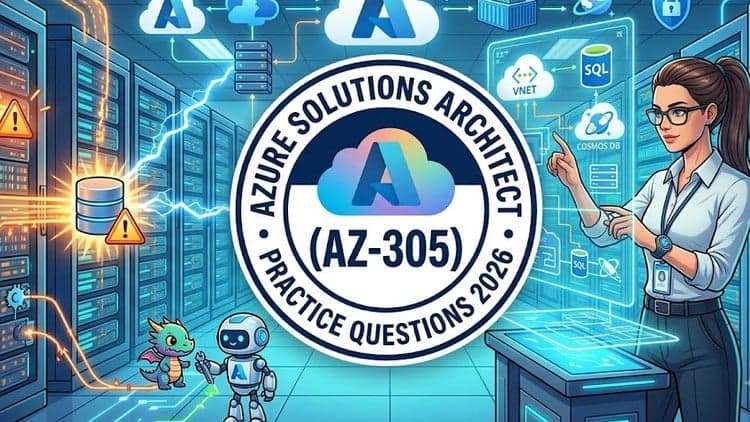
Are you ready to pass the AZ-305 exam? I know how hard studying for a professional certification can be. You read long books and watch endless videos. But when the test day comes, the questions look completely different. That is why I built this course for you. We focus strictly on practice tests and real scenarios.Taking mock exams is the best way to prepare. It trains your brain to read the question carefully and find the right answer fast. In this course, I give you hundreds of test questions. They look and feel just like the real AZ-305 exam. This is the exact certification exam prep you need for 2026.I designed these practice exams to test your real knowledge. We do not just ask you to memorize facts. We put you in the shoes of a real cloud architect. You will face problems that companies deal with every day. This helps you understand the logic behind Microsoft Azure.Every time you answer a question, you get a clear explanation. If you get it wrong, I tell you exactly why. This means you are always learning. You do not just stare at a score. You understand your mistakes and fix them. This makes your exam preparation smooth and stress-free.I updated all the content to match the 2026 exam rules. Azure changes a lot, and you need the freshest information. Using old study materials is a big mistake. My test questions cover the newest features and limits. You can trust that what you learn here will actually show up on your test.We will walk through all the main topics together. You will see questions about networking, databases, and security. I also included many questions about saving money in the cloud. Companies care a lot about cloud costs. You will learn how to design systems that are both cheap and powerful.Many students fail their first try because they lack practice. They know the facts but fail the scenario-based questions. The AZ-305 exam loves to give you long stories. You have to pick the best tool out of four good options. My mock exams teach you how to spot the hidden clues in those stories.I focus heavily on finding the cheapest solution. Azure asks many questions about cost management. You might see a question where two answers work perfectly. But one answer costs half the price. I will teach you how to pick the money-saving option every time. This is exactly what real companies want you to do.Another big part of our exam preparation is data storage. You will see many questions about SQL and Cosmos DB. I made sure to include practice questions that test your database knowledge. You will learn when to use a normal database and when to use a NoSQL option. I explain the limits and speeds of each one.We also spend a lot of time on security. You need to know how to lock down your networks and protect user passwords. My practice tests cover virtual networks, firewalls, and encryption tools. You will practice securing systems from outside hackers and internal mistakes.You can take these practice tests as many times as you want. Repetition is a great way to learn. Try to beat your old score each time. Read the detailed explanations even when you get the answer right. Sometimes you guess correctly, but you still need to learn the real reason.I highly recommend setting aside quiet time to take these tests. Treat them like the real thing. Put away your phone and time yourself. This builds your focus and stamina. The real AZ-305 exam is long, and you need to keep a clear head the whole time.After you finish a mock exam, grab a notebook. Write down the topics you got wrong. If you miss a question about Azure Backup, go read about it. Then come back and take the test again. This cycle of testing and reviewing is the fastest way to learn.My goal is to make you feel confident on exam day. When you sit down at the testing center, you will not feel nervous. You will look at the screen and recognize the patterns. You will say, "I have seen this before." That is the power of good mock exams.Do not leave your professional certification to chance. Passing the AZ-305 changes your career. It proves to employers that you know how to design big cloud systems. This course gives you the exact tools to prove your skills. Let us work together to get you certified.What You’ll LearnDesign secure identity and access rules for Azure.Choose the right data storage for different apps.Set up fast and safe virtual networks.Build backup plans to stop data loss.Connect different app parts using cloud queues.Move old local servers to the cloud easily.Keep your monthly cloud bills low.Block hackers with smart security tools.Understand real exam questions and scenarios.Pick the best and cheapest cloud tools for any job.Course FeaturesFull practice exams updated for 2026.Realistic exam questions based on actual scenarios.Clear and detailed explanations for every answer.Self-paced learning to fit your schedule.Focused certification preparation.Mobile-friendly format to study anywhere.Lifetime access to all practice materials.Course StructureSection 1: Design Identity, Governance, and Monitoring Solutions In this first section, we look at how to control who gets into your cloud network. You will learn about rules that keep your setup safe and organized. I will also show you how to track what is happening inside your systems every day.Section 2: Design Data Storage Solutions This part is all about where to keep your files and databases. We explore different ways to save money while keeping your data fast and easy to reach. You will understand which storage type fits different types of applications.Section 3: Design Infrastructure Solutions Here, we focus on building the main bones of your cloud setup. You will learn how to connect networks securely and choose the right virtual machines. I will guide you on how to make these computer parts talk to each other safely.Section 4: Design Business Continuity Solutions This section prepares you for the worst-case scenarios. We cover how to back up your data and keep your apps running if a disaster hits. You will see how to build a safety net so your business never goes offline.Section 5: Design Application Architectures and Migrations Now we look at moving old systems into the cloud smoothly. You will learn how to connect different app pieces using messaging tools and queues. I will also show you how to upgrade your old setups using modern cloud services.Section 6: Design Security, Operations, and Cost Management In our final section, we put a strong lock on your whole environment. You will find out how to stop hackers and keep your monthly bills as low as possible. We wrap up by making sure your daily operations run without a hitch.Who This Course Is ForIT workers who want to become Azure Architects.Students preparing for the AZ-305 certification exam.Cloud engineers looking to test their skills safely.People who learn best by taking practice tests.System admins moving to Microsoft Azure.Anyone needing clear explanations of Azure tools.RequirementsBasic knowledge of cloud computing concepts.Familiarity with the Microsoft Azure portal.A strong desire to learn and pass the AZ-305 exam.A computer or mobile device with internet access.Why Take This CourseTaking this course gives you the exact practice you need to pass. Reading books is good, but applying that knowledge is better. These mock exams train you to think like an expert. You will learn how to read tricky questions and find the right answers quickly.Exam Preparation StrategyPractice exams are the secret to passing professional tests. They show you exactly where your weak spots are. You take a test, read my detailed explanations, and learn from your mistakes. This cycle builds real confidence so you never freeze up on test day.Career BenefitsGetting your AZ-305 certification opens major doors. Companies pay top money for people who know how to build cloud systems correctly. This badge proves you can design safe, fast, and cheap solutions. It makes your resume stand out and helps you get better jobs.Disclaimer: This course is not affiliated with, licensed, or endorsed by Microsoft. All trademarks belong to their respective owners. This is an independent exam preparation tool.  Rest assured, these aren't leaks. They are custom-developed practice questions, specifically engineered using advanced research tools to match the 2026 exam standards.

0.0•4•Self-paced
FREE$88.99
Enroll
AWS DevOps Engineer Professional DOP-C02 [Test 2026]
IT & Software
0% OFF

AWS DevOps Engineer Professional DOP-C02 [Test 2026]

Udemy Instructor

Prepare with confidence for the AWS Certified DevOps Engineer – Professional (DOP-C02) exam with this comprehensive mock exam course. This course includes six full-length practice exams carefully designed to mirror the latest AWS exam structure and question styles. Each question is accompanied by detailed explanations so you not only know the correct answer but also understand the reasoning behind it.Whether you are a DevOps engineer, cloud architect, or experienced AWS professional aiming to validate your expertise, this course will help you assess and strengthen your knowledge of CI/CD pipelines, infrastructure as code, monitoring, security, and automation on AWS. You will encounter questions covering key AWS services such as CodePipeline, CodeBuild, CodeDeploy, CloudFormation, CloudWatch, Systems Manager, Lambda, ECS, EKS, and other essential tools used to build and manage DevOps workflows in AWS environments.The mock exams are designed to simulate the real certification testing experience, helping you build the focus, accuracy, and confidence required to perform well on exam day.By the end of this course, you will gain a realistic evaluation of your exam readiness, deepen your understanding of DevOps best practices on AWS, and approach the AWS Certified DevOps Engineer – Professional exam with confidence.Frequently Asked Questions (FAQ)Can I retake the practice tests?Yes! You can attempt each practice exam as many times as you like. After every attempt, your final score will be displayed. To maintain variety, both the questions and answer choices are randomized each time you retake the exam.What score do I need to pass?You need a score of 70% or higher on each practice exam to pass.Do the questions include explanations?Yes. Every question includes a clear and detailed explanation to help you understand why an answer is correct or incorrect.Can I review my answers after completing a test?Yes. After finishing a practice exam, you can review all questions and see which answers were correct and which were not.Are the questions regularly updated?Absolutely. The question set is periodically updated to ensure it remains accurate, relevant, and aligned with the current AWS certification standards.Pro TipFor the best preparation results, it is highly recommended that you take the practice exams multiple times until you consistently achieve scores of 90% or higher. Repeated practice improves both your confidence and exam readiness. Start your preparation today and move one step closer to earning your certification!

5.0•286•Self-paced
FREE$93.99
Enroll
OTCA:OpenTelemetry Associate ─ 1500 Certified Exam Questions
IT & Software
0% OFF

OTCA:OpenTelemetry Associate ─ 1500 Certified Exam Questions

Udemy Instructor

As cloud-native applications, Kubernetes platforms, microservices architectures, and distributed systems become the standard across modern organizations, the need for a robust observability strategy has never been greater. Today's enterprises generate massive volumes of operational data from applications, infrastructure, and services. Transforming that data into actionable insights requires far more than traditional monitoring tools. It requires a deep understanding of OpenTelemetry, the industry's leading open-source observability framework, enabling the collection, processing, and analysis of metrics, distributed traces, and logs across modern technology environments.The OpenTelemetry Associate Certification (OTCA) validates the foundational knowledge required to understand, implement, and operate OpenTelemetry solutions within modern observability platforms. As organizations continue investing in Site Reliability Engineering (SRE), Application Performance Monitoring (APM), cloud-native infrastructure, and real-time operational visibility, professionals are increasingly expected to understand architectures, telemetry data flows, and operational practices that provide comprehensive insight into application and system behavior.This practice test course is designed to help you develop those capabilities through an intensive, certification-focused learning experience. Rather than relying on passive memorization, you will strengthen your knowledge through realistic certification-style questions that reflect the concepts, decisions, and scenarios encountered by software engineers, SRE teams, DevOps professionals, platform engineers, cloud administrators, and observability specialists working in production environments.This course contains 1,500 carefully crafted questions, organized into 6 complete sections with 250 questions each, providing comprehensive coverage of the major domains tested on the OpenTelemetry Associate (OTCA) certification exam.In the first section, OpenTelemetry Architecture, Observability Foundations & Telemetry Signals, you will build a strong foundation in observability concepts, telemetry signals, OpenTelemetry architecture, semantic conventions, application instrumentation, resource attributes, and the lifecycle of telemetry data within distributed systems.In the second section, Metrics Instrumentation, Aggregation & Performance Monitoring, you will focus on metrics, including counters, gauges, histograms, aggregations, exporters, dimensional metrics, resource attributes, monitoring strategies, and techniques used to measure and analyze system performance.In the third section, Distributed Tracing, Span Analysis & Context Propagation, you will explore traces, spans, parent-child span relationships, attributes, events, links, baggage, context propagation, W3C standards, and techniques for tracking requests across complex distributed architectures.In the fourth section, Logging Architecture, Telemetry Correlation & Troubleshooting Workflows, you will examine structured logging, log records, telemetry correlation, incident analysis, troubleshooting methodologies, and techniques for connecting logs, metrics, and traces into unified observability workflows.In the fifth section, OpenTelemetry Collector, Data Pipelines & Telemetry Processing, you will gain detailed knowledge of the OpenTelemetry Collector, including receivers, processors, exporters, connectors, data routing, filtering, batching, transformations, scaling strategies, and management of telemetry pipelines in production environments.In the sixth section, Production Deployments, Security, Optimization & Operational Excellence, you will focus on deployment strategies, security controls, resource management, performance optimization, system reliability, organizational compliance requirements, operational resilience, and best practices for managing OpenTelemetry platforms at scale.Every question includes multiple answer choices, a clearly identified correct answer, and a detailed explanation designed to help you understand not only why an answer is correct, but also how the underlying concept applies in real-world production environments.By the end of this course, you will not only be prepared to confidently pass the OpenTelemetry Associate (OTCA) certification exam, but you will also develop a deeper understanding of observability architectures, telemetry signals, metrics, distributed tracing, logging, OpenTelemetry Collector, telemetry pipelines, security, performance monitoring, and the technologies that power modern cloud-native and enterprise platforms. You will understand how organizations use observability to improve reliability, accelerate troubleshooting, optimize performance, and gain operational insight across complex distributed systems.

0.0•0•Self-paced
FREE$94.99
Enroll
FreeCourse LogoFreeCourse

Freecourse.io brings you high-quality online courses with free certificates to help you upskill, boost your career, and achieve your goals anytime, anywhere.

Resources

  • Courses
  • Jobs
  • Categories
  • Features

Company

  • About
  • Blog
  • Contact

Legal

  • Privacy
  • Terms
  • Cookies
  • Licenses

© 2026 FreeCourse. All rights reserved.