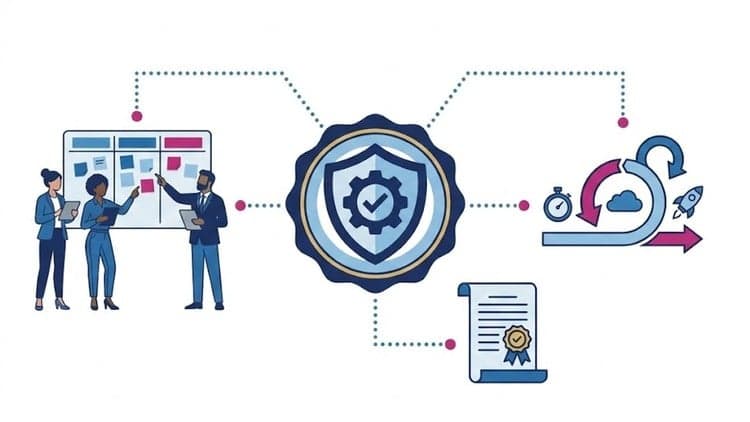
Agile Management Certification
About this course
This course is designed to help learners prepare effectively for an Agile Management Certification exam that uses multiple‑choice questions as its main assessment method. Many candidates understand Agile concepts at a surface level but struggle during exams due to unclear wording, tricky options, or time pressure. This course addresses those challenges by combining clear explanations of Agile principles with targeted MCQ practice and exam strategies.The course begins with a solid overview of Agile management.
Learners review the Agile Manifesto, including its values and principles, and understand why Agile was created and how it differs from traditional project management approaches. The focus is on management and leadership within Agile environments, not just team execution. Participants learn how Agile changes the role of managers, emphasizing collaboration, adaptability, and continuous improvement.A large part of the course is dedicated to Scrum, as it is the most common framework tested in Agile certification exams.
Learners study Scrum roles such as Product Owner, Scrum Master, and Development Team, with close attention to responsibilities and common misconceptions. The course explains Scrum events, including Sprint Planning, Daily Scrum, Sprint Review, and Sprint Retrospective, highlighting their purpose, time limits, and expected outcomes. Scrum artifacts such as the Product Backlog, Sprint Backlog, and Increment are also covered in detail, with exam‑focused explanations that clarify what is often confused in MCQs.Beyond Scrum, the course introduces other Agile frameworks and practices that often appear in certification exams.
These include Kanban, Extreme Programming (XP), Lean principles, and scaling approaches at a high level. Learners understand when each approach is appropriate and how they differ in terms of flow, planning, and roles. This helps candidates handle comparison questions and scenario‑based MCQs with more confidence.The course places strong emphasis on Agile management and leadership.
Participants learn how Agile managers support teams, remove obstacles, and promote self‑organization rather than command‑and‑control behavior. Topics such as servant leadership, empowerment, stakeholder collaboration, and transparency are explained clearly and linked directly to exam questions. Common exam traps, such as confusing the Scrum Master role with that of a traditional project manager, are addressed directly.Another key area covered is Agile planning and estimation.
Learners review concepts such as product vision, roadmaps, release planning, and sprint goals. Estimation techniques like story points, relative estimation, planning poker, and velocity are explained in simple terms. The course shows how these concepts are commonly tested in MCQs and how to identify the best answer even when several options seem correct.Quality, risk, and continuous improvement are also important exam topics.
The course explains how Agile approaches quality through practices like definition of done, continuous integration, and frequent feedback. Risk management in Agile is discussed from a practical perspective, focusing on early delivery, transparency, and inspection. Retrospectives and metrics such as burndown charts and cumulative flow diagrams are explained with exam relevance in mind.Throughout the course, learners practice a large number of MCQs that reflect real exam difficulty and style.
Each question is followed by a clear explanation of why the correct answer is right and why the other options are wrong. This approach helps learners build deep understanding rather than memorizing answers. The course also teaches strategies for handling difficult questions, such as eliminating incorrect options, identifying keywords, and managing time effectively during the exam.Special attention is given to common mistakes made by exam candidates.
These include overthinking simple questions, misreading keywords like “best,” “first,” or “most appropriate,” and applying traditional project management logic to Agile scenarios. By learning to recognize these patterns, participants improve both accuracy and confidence.By the end of the course, learners will have a structured understanding of Agile management concepts and strong familiarity with MCQ exam formats. They will know how to approach different types of questions, from direct definition checks to complex scenario‑based problems.
The course prepares participants not only to pass the Agile Management Certification exam but also to understand how Agile management works in practice.This course is ideal for anyone who wants a focused, practical, and exam‑oriented approach to Agile management. It avoids unnecessary theory and concentrates on what is most likely to appear in certification exams, while still building real understanding that can be applied in the workplace.
Skills you'll gain
Available Coupons
Course Information
Level: All Levels
Suitable for learners at this level
Duration: Self-paced
Total course content
Instructor: Udemy Instructor
Expert course creator
This course includes:
- 📹Video lectures
- 📄Downloadable resources
- 📱Mobile & desktop access
- 🎓Certificate of completion
- ♾️Lifetime access
You May Also Like
Explore more courses similar to this one