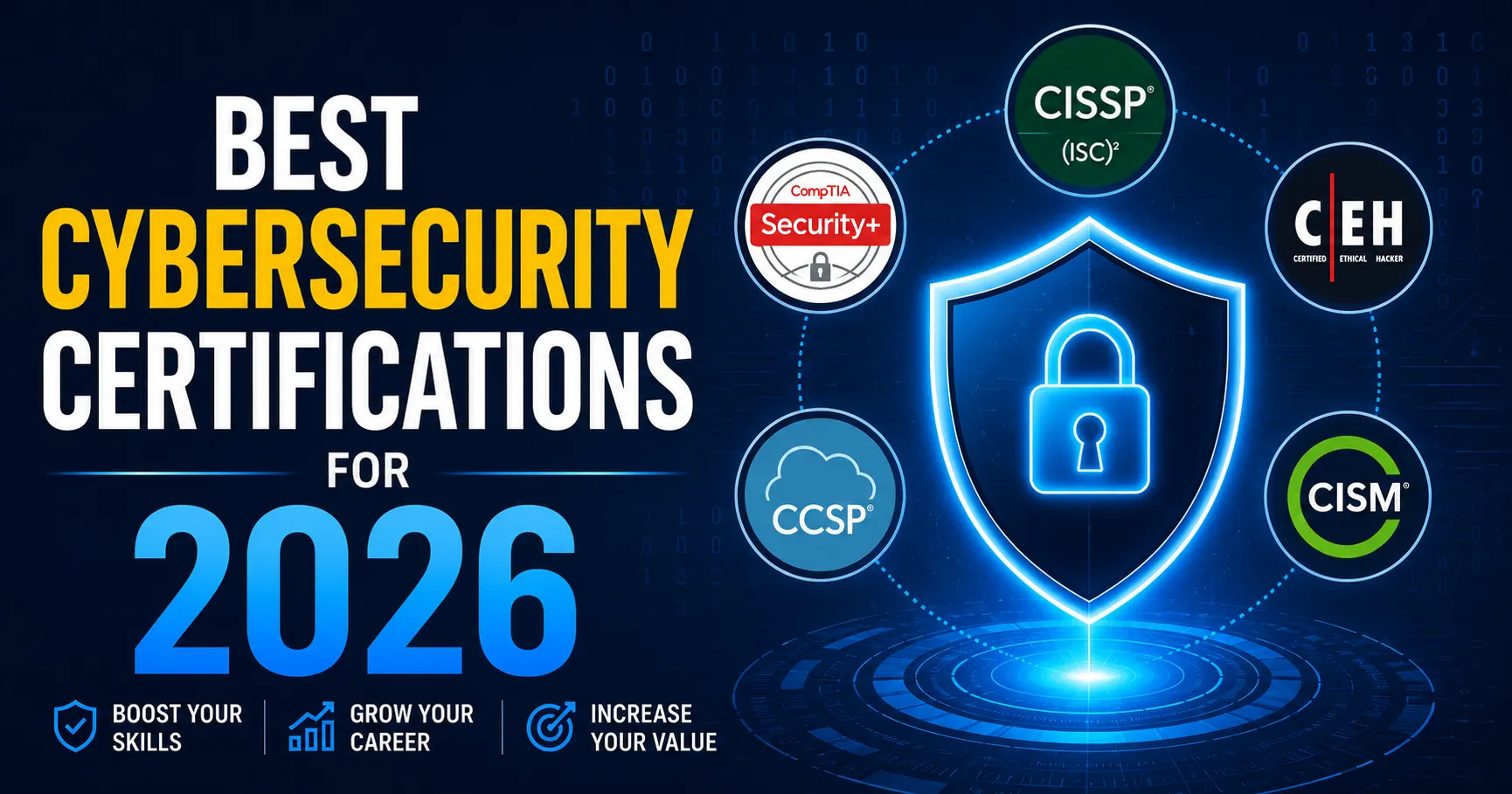
Best Cybersecurity Certifications for 2026: Compare CISSP, Security+, OSCP & more to boost skills, salary, and career growth.
Chethan Yadav
coursevania
Published on June 16, 2026
In an era defined by digital transformation, the significance of robust cybersecurity cannot be overstated. As technology continues to evolve at an unprecedented pace, so do the complexities and sophistication of cyber threats. This article delves into the landscape of cybersecurity certifications, offering an in-depth analysis of the best options available for cybersecurity professionals in 2026, ensuring they are well-equipped to safeguard our increasingly interconnected world by implementing effective security practices.
Overview of Cybersecurity Certifications in 2026
Importance of Cybersecurity Certifications
Cybersecurity certifications in 2026 are more crucial than ever, serving as a benchmark for expertise and dedication in a rapidly evolving field. For cybersecurity professionals, obtaining a reputable cybersecurity certification not only validates their skills in areas like network security, cloud security, and risk management but also significantly enhances their career prospects. These certifications demonstrate a commitment to staying current with the latest cyber threats and defense mechanisms, which is vital for any security professional aiming to excel in security operations or security architecture roles.
Current Trends in Cybersecurity
The current trends in cybersecurity are heavily influenced by the pervasive integration of cloud technologies and the escalating sophistication of cyber threats. There's a pronounced shift towards specialized skills, making certifications focused on these areas particularly valuable. These include:
Cloud security
Data security
Enterprise security
Furthermore, the demand for security analysts proficient in penetration testing and security program management continues to rise, reflecting the industry’s proactive stance against potential breaches. Popular cybersecurity certifications now often incorporate modules addressing these cutting-edge challenges.
Future Predictions for Cybersecurity
Looking ahead to 2026, future predictions for cybersecurity point towards an even greater emphasis on artificial intelligence and machine learning in detecting and mitigating cyber threats. The landscape will demand cybersecurity professionals with advanced cybersecurity skills in areas such as predictive analytics for risk management and automated security responses. Certifications for 2026 will undoubtedly evolve to include competencies in securing IoT devices and critical infrastructure, further cementing the need for continuous learning and specialized security certification to combat emerging cyber threats effectively.
Top Cybersecurity Certifications for 2026
Certified Information Systems Security Professional (CISSP)
The Certified Information Systems Security Professional (CISSP) remains an exemplar among cybersecurity certifications in 2026, recognized globally as a gold standard for experienced cybersecurity professionals. This cybersecurity certification is ideal for security professionals aiming for leadership roles in information security, such as:
Security Architect
Security Manager
Director of Security Operations
CISSP validates an individual's expertise across eight critical domains of information security, encompassing security and risk management, asset security, security architecture and engineering, communication and network security, identity and access management, security assessment and testing, security operations, and software development security. Achieving CISSP signifies a deep understanding of cybersecurity principles and practices, making it one of the best cybersecurity certifications for career advancement.
OSCP certification
In the context of "top 5 cybersecurity courses for 2026", the Offensive Security Certified Professional (OSCP) certification remains a premier hands-on credential for aspiring and experienced penetration testers. Offered by Offensive Security and based on the Penetration Testing with Kali (PWK) course, OSCP emphasizes practical exploitation, real-world attack scenarios, and a rigorous 24- to 48-hour certification exam that tests both technical skills and problem-solving under pressure.
Why OSCP is valuable for 2026 job seekers:
Employer recognition: Widely respected by hiring managers for evidence of real-world penetration testing capability.
Practical focus: Demonstrates hands-on competence over purely theoretical knowledge, which aligns with employer demand for actionable skills in offensive security roles.
Career pathways: Commonly lead to roles such as penetration tester, red team operator, security consultant, and vulnerability researcher.
Overall, OSCP remains a top choice among the "top 5 cybersecurity courses for 2026" for professionals seeking a respected, hands-on credential that proves practical offensive security skills and enhances employability in penetration testing and red teaming roles.
CompTIA Security+
CompTIA Security+ is a foundational cybersecurity certification that serves as an excellent starting point for individuals entering the cybersecurity field, particularly those interested in online cybersecurity certifications. As one of the most popular cybersecurity certifications, it provides a broad understanding of core security functions, making it suitable for beginner cybersecurity professionals. In 2026, Security+ continues to be highly recommended for anyone seeking to establish a strong base in security operations, network security, and risk management. This certification covers essential principles like threat management, vulnerability management, application security, host security, cloud security, and cryptographic concepts. For individuals without prior experience, CompTIA Security+ is often cited as one of the best cybersecurity certifications to acquire, opening doors to various entry-level cybersecurity roles and further specialized security certifications.
Best Cybersecurity Courses and Certifications
Online Cybersecurity Courses
The landscape of cybersecurity education has been significantly reshaped by the proliferation of online cybersecurity courses, offering unparalleled flexibility and accessibility for aspiring and current cybersecurity analysts and professionals. These online platforms provide a comprehensive range of content, from beginner-friendly introductions to advanced specializations in areas like cloud security and penetration testing. Many of these online cybersecurity courses are meticulously designed to align with the curriculum of top cybersecurity certifications, preparing individuals for exams such as CompTIA Security+ or even more complex certifications in 2026. The convenience of remote learning allows individuals to enhance their cybersecurity skills and pursue various cybersecurity certifications at their own pace, making them an invaluable resource for career advancement in cybersecurity.
Hybrid Learning Options
Hybrid learning options represent a strategic blend of online instruction and in-person engagement, providing a balanced approach to acquiring robust cybersecurity skills. This model is particularly beneficial for cybersecurity professionals seeking the flexibility of digital learning combined with the interactive, hands-on experience often found in traditional classroom settings. Hybrid courses frequently incorporate practical workshops and collaborative exercises that are crucial for mastering complex concepts in network security, information security, and risk management, aligning with current best practices. This approach can be ideal for preparing for popular cybersecurity certifications, as it allows for direct engagement with instructors and peers, fostering a deeper understanding and application of cybersecurity principles relevant to security operations and security architecture roles.
Hands-on Training and Labs
Hands-on training and labs are indispensable components of effective cybersecurity education, providing practical experience that theoretical knowledge alone cannot replicate. These immersive environments allow cybersecurity professionals to apply their cybersecurity skills in realistic scenarios, tackling actual cyber threats and implementing security measures in controlled settings. For those pursuing the best cybersecurity certifications, hands-on labs are crucial for developing proficiency in areas such as penetration testing, data security, and enterprise security. Many top cybersecurity certifications now require or strongly recommend practical lab experience, recognizing its importance in preparing security analysts and security engineers for the complexities of real-world security management and robust security program implementation in 2026.
Cybersecurity Career Pathways
Becoming a Cybersecurity Professional
Embarking on a cybersecurity career path in 2026 demands a strategic approach, blending foundational knowledge with specialized cybersecurity skills. Aspiring cybersecurity professionals should focus on acquiring a strong understanding of network security, information security principles, and risk management. Obtaining a relevant cybersecurity certification, even an entry-level one like CompTIA Security+, can significantly enhance a beginner's prospects. For those aiming higher, pursuing top cybersecurity certifications will validate expertise in areas like security operations or security architecture, proving invaluable for navigating the complex landscape of cyber threats and securing a fulfilling cybersecurity role.
Roles and Responsibilities of Security Engineers
Security engineers play a vital role in managing security incidents and developing robust defenses against cyber threats. pivotal role in safeguarding an organization’s digital assets, making their responsibilities highly demanding and critical. These cybersecurity professionals are tasked with designing, implementing, and maintaining robust security architectures to defend against sophisticated cyber threats, ensuring adherence to best practices. Their daily duties often involve developing security policies, conducting vulnerability assessments, configuring firewalls, and managing intrusion detection systems. Possessing specialized cybersecurity certifications in areas such as cloud security or enterprise security is crucial for a security engineer, as it demonstrates the advanced cybersecurity skills needed to manage complex security programs and ensure comprehensive security management in 2026.
Career Opportunities in Cybersecurity
The burgeoning field of cybersecurity offers a wealth of career opportunities for individuals with diverse skill sets. Beyond the traditional roles of security analysts and security engineers, there's a growing demand for experts in penetration testing, data security, and security management. The expansion of cloud computing also fuels demand for cloud security specialists, making 2026 certifications focused on this area particularly valuable. A well-defined cybersecurity career path often involves continuous learning and acquiring various cybersecurity certifications, which are vital for career advancement and staying ahead of evolving cyber threats in this dynamic industry.
Choosing the Right Certification for You
Assessing Your Career Goals
Selecting the best cybersecurity certification for your individual needs begins with a thorough assessment of your long-term career goals within cybersecurity, especially if you aim for an entry-level certification. For a beginner aiming for an entry-level position in security operations, a foundational cybersecurity certification like CompTIA Security+ might be ideal. Conversely, an experienced security professional aspiring to a leadership role in information security or security architecture should consider advanced cybersecurity certifications such as CISSP, which demonstrates extensive expertise in risk management and security program development. Clarifying your career aspirations ensures you invest in a certification that genuinely propels your cybersecurity career forward in 2026.
Factors to Consider When Selecting Certifications
When selecting among the best cybersecurity certifications for 2026, consider the emerging trends in managing security incidents. several factors warrant careful consideration when choosing the best certifications in cybersecurity. The relevance of the cybersecurity certification to current industry demands, particularly in areas like cloud security, data security, and network security, is paramount. Furthermore, assess the recognition and reputation of the certification within the cybersecurity community, as top cybersecurity certifications often carry more weight with potential employers. Practical application of cybersecurity skills gained, through hands-on labs or real-world scenarios, should also influence your choice, ensuring the certification equips you for actual cyber threats and effective security management.
Cost and Time Investment
The cost and time investment associated with pursuing a cybersecurity certification are significant factors that prospective cybersecurity professionals must weigh carefully. Some of the best cybersecurity certifications, while highly valuable, can entail substantial examination fees, study materials, and potentially the cost of online cybersecurity courses or hands-on training. The time commitment can also range from a few weeks for popular beginner cybersecurity certifications to several months or even years for advanced top cybersecurity certifications. It’s essential to balance your budget and available study time against the long-term career benefits and potential return on investment for your chosen cybersecurity certification in 2026.